By Shi Shi, Yang Yulai, SFC, 21st Century Business Herald
Editor’s Note:
As the world moves toward 2026, multiple economic cycles and structural shifts are converging. Global growth remains uneven, inflation and monetary policy paths are uncertain, and geopolitical tensions and industrial realignments continue to reshape the international order. At the same time, China enters the starting phase of 15th Five-Year Plan, with implications that extend well beyond its borders.
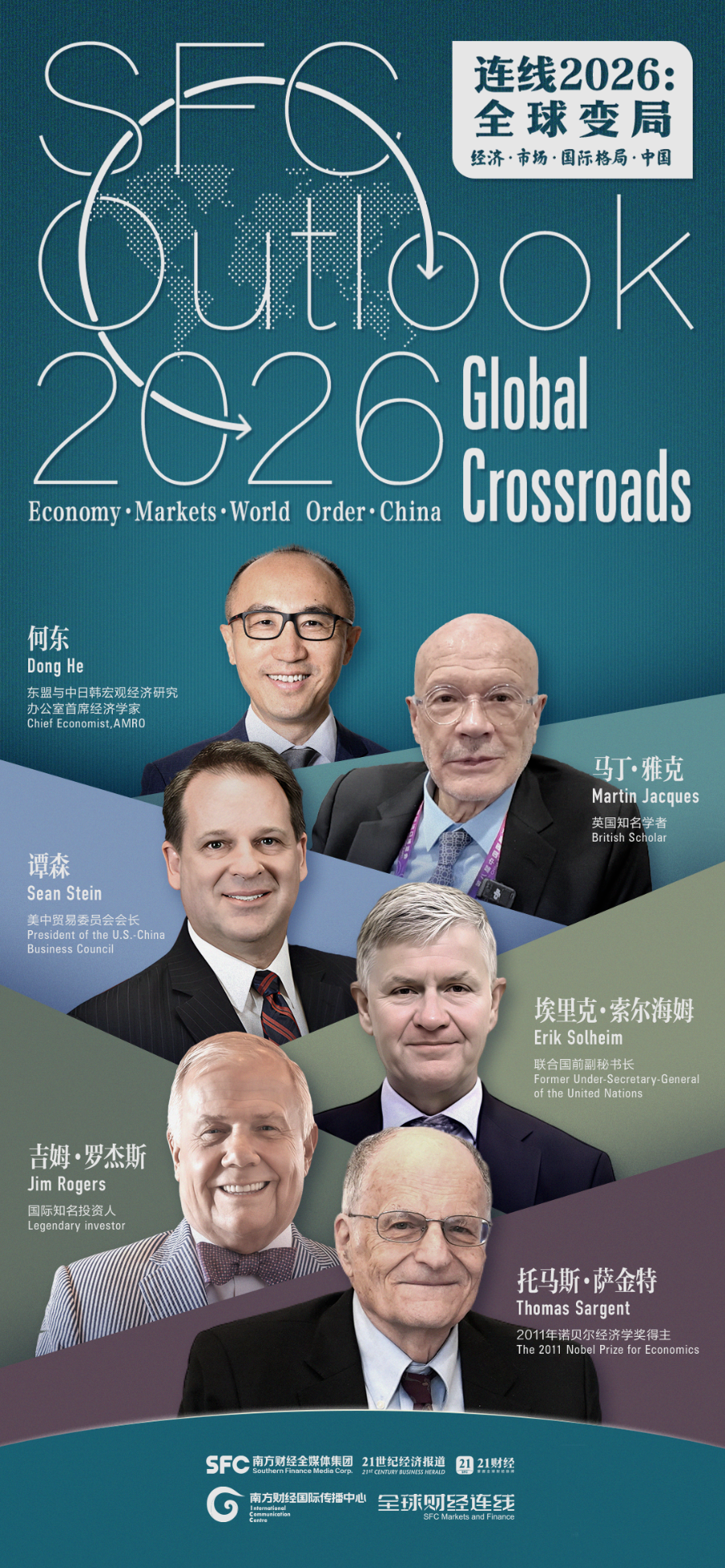
SFC Outlook 2026: Global Crossroads brings together distinguished economists, scholars, investors and political figures to assess the global economy, financial markets, the evolving world order, and China’s development at this critical juncture. Through in-depth conversations and forward-looking perspectives, the series offers a comprehensive outlook on the forces shaping the years ahead.
As China enters the first year of its 15th Five-Year Plan in 2026, expectations are building around the direction of economic policy and the role of foreign businesses in the next phase of development. In an exclusive interview with SFC, Sean Stein, President of the U.S.-China Business Council (USCBC), shared his observations from the business front line and outlined his outlook on China’s economic priorities and China–U.S. economic engagement.
Reflecting on recent developments, Stein points to steady progress in areas such as intellectual property protection, market access, and the implementation of national treatment, noting that these changes are gradually improving the operating environment for global companies in China. Looking ahead, he highlights consumption-led growth as a key theme for the coming years, expressing hope that clearer policy targets and pilot initiatives can help unlock domestic demand and create new momentum for both Chinese and international firms.
Turning to bilateral relations, Stein underscores that commercial ties between China and the United States continue to move forward despite uncertainties. He notes that American companies remain active in China across a wide range of sectors, often working alongside Chinese partners to serve both the domestic and global markets.
In 2026, Stein adds, deeper dialogue and practical cooperation will be essential to fostering a more stable and sustainable economic relationship between the two countries.
Expect China to rebalance towards consumption
SFC Markets and Finance: 2026 is the first year of the 15th Five-Year Plan. What are you looking for?
Sean Stein: The first thing that made me encouraged is last August, NDRC hosted a meeting with foreign companies. And that gave the business community an opportunity to lay out the types of goals and objectives that they hope will be expressed in the plan. And those were the types of things for the foreign business community that you would expect. It's that China will finish the work that it started on creating national treatment for all companies in China that manufacture in China. They'll create more for equal treatment of all intellectual property wherever that intellectual property comes from. That's what we're looking for, is the types of things that we've been working on for many years.
But me personally, what I'm hoping to see is there's been more and more talk about trying to rebalancing towards consumption. And we've seen some really good early steps, maybe even pilot cases for how do you promote consumption in a way that's responsible. Our hope is that we'll see a statistic announced in the targets. There'll be a target somehow related to consumption, because once there's a target, then everybody will focus on, everyone will take it seriously and everyone will make sure that's met. So we've spoken a long time about consumption, but that I think would be what I'd really like to see, would be some sort of consumption that a target.
CIIE is a good platform for companies and government
SFC Markets and Finance: Opening up is one of eight economic priorities for 2026. The CIIE serves as a key platform for foreign firms to observe China's high-standard opening up. What do you think about the CIIE? Any advices?
Sean Stein: I've gone to the CIIE many times and the great thing about the CIIE is everybody is there, every major company in the world is there, and it's organized by theme, so that you can easily see industry by sector. But it is so large, that what they need to do is they need more golf cars, or more ways to get around, more bicycles or more scooters, because the site is so enormous, because there are so many, thousands of companies there that it's really hard to get from place to place.
The point is, it's such a big show. There is nothing else like it anywhere in the world. Even if you spend several days there, it's really hard to see more than a small fraction of it.
SFC Markets and Finance: The USCBC is also a key participant in the CIIE. Could you share more details on this?
Sean Stein: What we do is every year in Shanghai, we have two meetings. One of them is we have a meeting that's closed door where we bring all of our members together, and we talk about what's happening in the economy, what's happening in reform, what are the opportunities, what are the challenges, and we learn from each other about what's happening in China. So it's a very good conference and opportunity for companies to share their experience, to maybe share perspectives on what are the opportunities.
We also have a big dinner where we invite the American companies. I think this year we had 160 or 170 Chinese government officials along with the American companies. And it's really important because those officials were from more than 16 provinces. So all of those provinces have got American companies and all of them want to attract more American companies.
This becomes an opportunity for companies to talk to governments, and governments to talk to companies about where they're good fits. And we have provinces that are very eager to increase the number of American companies that are there. This is an opportunity for them to talk to the leadership of those companies and explain why it is that they're a good place. It's the same thing for companies that are looking to expand or have issues in different regions, to talk to government officials from there.
U.S. companies are still committed to working in China
SFC Markets and Finance: What progress has been made on projects or deals between USCBC members and the local government?
Sean Stein: Yes, but I can't talk about them. But what I can say is there's a lot of discussion about investment declining in China. And it's true, there is less investment, but it's also true that there's still a lot of investment that's coming in. And it's coming in for good reasons. It's coming in because as Chinese companies go global, part of their supply chain comes from the United States or comes from American companies. And so American companies are investing here because they're partnering with Chinese companies and boosting Chinese exports.
We also see companies in the life science and pharmaceutical sector coming here and investing because they're doing joint development of drugs and medication together, they're doing joint trials of medicine, they're doing different projects here together, they're manufacturing here together in China and they're selling globally. We see it in many sectors, but the point is that investment continues, maybe not as much as it was before, maybe not as loudly announced as it was before, but it's absolutely still happening and American companies are still committed to partnering and operating and working in China like they do in every other country around the globe.
SFC Markets and Finance: What will the USCBC do to promote China-US trade cooperation?
Sean Stein: We'll do what we've always done, and that's a couple of things.
The first thing is we try to provide the best information and advice we can to both governments. Because we work with a lot of very large companies, we get a lot of insights into what's happening in different sectors, and sometimes the governments don't always have that same level of detail and that same level of insight. And so we try to talk to both governments about their policies and what they're doing and how that affects business. We have done this with the American government and with the Chinese government.
We do that because our belief is that business is good for the two countries, more trade is good for the two countries, more investment is good for the two countries, whichever direction it's going. So we would also say having more Chinese companies in America is good for everyone, and more American companies here is good for everyone. So the first thing we do is trying to provide good advice and good information to both governments.
The second thing we try to do, and I think this is equally important, is that with so many members and regular communication with both governments, we are able to talk to companies and help them understand where the opportunities are, where the challenges are, and what strategies might be effective. And in that way, we are also promoting bilateral cooperation.
And then the third thing is that every year we sponsor a very high-level visit of global CEOs to China to make sure they come here. They meet with Chinese officials, they meet with Chinese businesses and they look around and see for themselves. Because if you ask me, the number one problem we have between America and China right now is that we don't have enough mutual understanding, and we don't have enough Americans—whether it's American government officials, American members of Congress, or even American CEOs—coming to understand the current situation firsthand. So we do that.
Chief Producer: Zhao Haijian
Supervising Producer: Shi Shi
Editor: Li Yinong
Reporter: Shi Shi, Yang Yulai
Video Editor: Cai Yutian
Poster Design:Lin Junming
New Media Coordination: Ding Qingyun, Zeng Tingfang, Lai Xi, Huang Daxun
Overseas Operations Supervising Producer: Huang Yanshu
Overseas Content Coordinator: Huang Zihao
Overseas Operations Editors: Zhuang Huan, Wu Wanjie, Long Lihua, Zheng Quanyi
Produced by: Southern Finance Media Gorp.