南方财经全媒体见习记者肖玥 上海报道
Sustainable development is on every country's agenda as more and more extreme weather has taken place in the past several years.
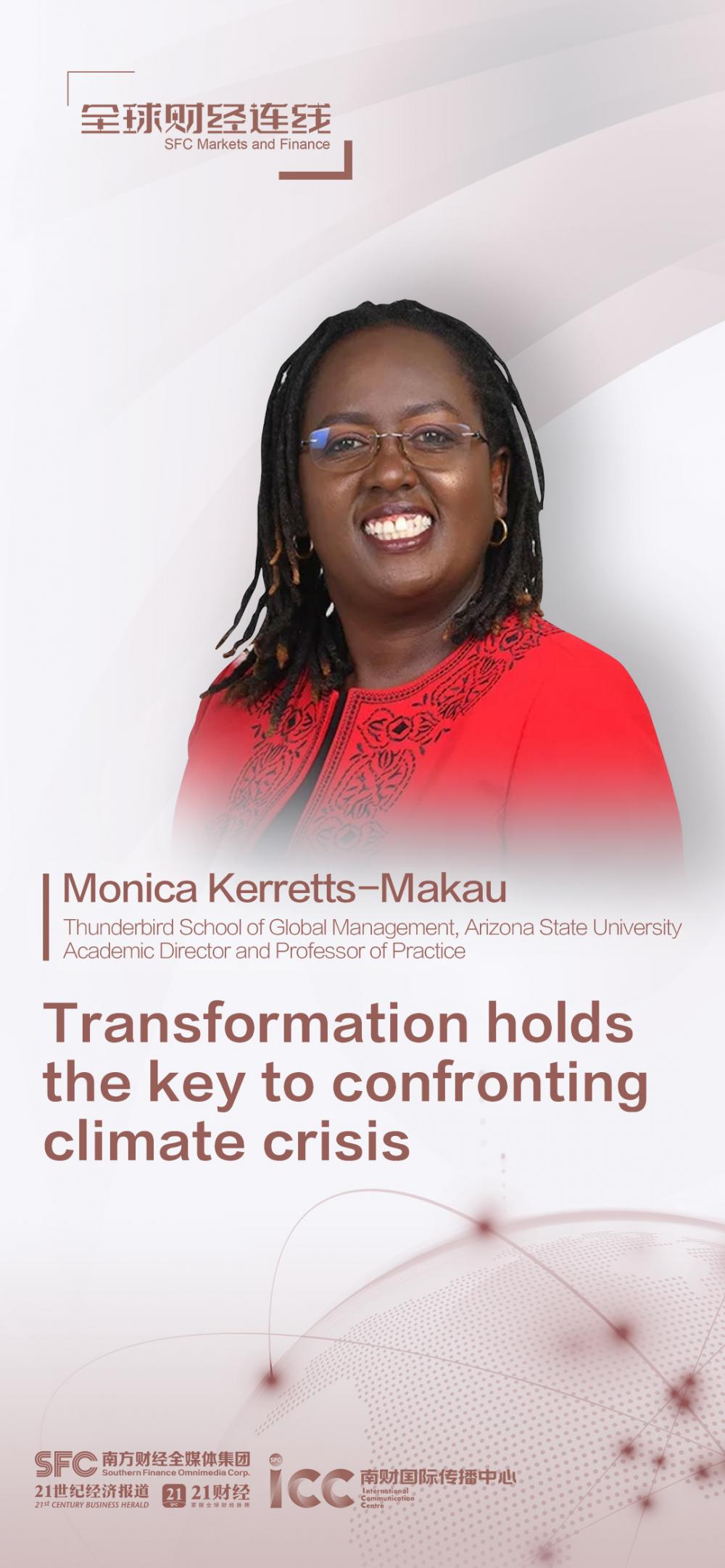
Dr. Monica Kerretts-Macau, Academic Director and Professor of Practice at the Thunderbird School of Global Management, Arizona State University, and also one of the authors of the GEO-7 report under UNEP, told SFC Markets and Finance in an inclusive interview that the core to confront the global climate crisis is transformation, and how fast mankind could really implement transformation solutions.
She emphasized the urgency to achieve global cooperation and to unite mankind as one solid community, as well as praised China's efforts in joining the Green Revolution. Talking about her recent research on Understanding and Improving Women's Work in Digital Spaces in Kenya in partnership with the International Labor Organization (ILO), Kerretts also stressed the importance of applying digital technologies to fulfilling sustainable development in the world.
SFC Markets and Finance: Today we invited our guest, Dr. Monica Kerretts-Makau. Could you please introduce yourself a little bit first?
Monica Kerretts-Makau: Okay. Hi, my name is Monica Kerretts-Makau. I'm a professor from Thunderbird School of Global Management, Arizona State University in the US, and I am the Academic Director for Africa. I also manage a program in Oman in the Middle East. I am also part of the GEO-7 team.
So, Unit GEO-7 is currently meeting here in Shanghai. Thank you for hosting us as a Shanghai team. We are really thinking through the climate crisis and thinking through what we are going to do and the solutions pathways. (We're) speak(ing) about climate change and what's happening around the world.
SFC Markets and Finance: The first question today is that we know that the Africa Climate Summit is held right now in Nairobi, do you have any comments about it?
Monica Kerretts-Makau: I think it's interesting that we are here for the UNEP Outlooks (Second) Author Writing Workshop, and at the same time, the Africa Climate Summit is going on. The Africa Climate Summit, first of all, is an important seminal meeting, the first of its kind, being headed and shared and hosted by President Ruto.
I think what's interesting about the Climate Summit is that it brings all the presidents of the continent and the leadership of the continent to begin to ask ourselves: how do we participate and be part of the climate crisis? Yes, indeed, African countries have borne the brunt of climate change, whilst we do not admit it. When you look at what we are doing, we did not pollute the world, but we are the ones who develop the brunt. But the conference, again, I will repeat, is not talking about or complaining about what has happened. We want to see how we move forward as African countries and sit at the table to discuss climate change. We want to be part of the green solutions and begin to think about green solutions that will tackle the problems that climate change has caused in the continents.
So, the meeting that's going on is really thinking about solutions, such as carbon financing, and how do we begin to repurpose the entire way because it is currently structured, to fit in and to support African governments. So that's what the meeting is about. It's going on. And it's really great that this is happening and discussions are happening. I think it's also important that this has been happening in light of a meeting that has also just been held recently, which is the BRICS conference that was held in South Africa, Johannesburg. (It's) also a seminar of its kind. China is part of the BRICS team. I think on that table as well climate change is also going to be a discussion that's going to be going forward in these countries.
The seminar now has a good block of the global south (experts) sitting on the table and saying we want to be part of the participants. And we want to make sure that conversations are around any area, whether it's financing, whether it's thinking through climate, whether it is thinking through how we even structure the monetary system that we are undertaking. So, I think important questions are going on for the continent and in the continent. As well, China is really part of that process of that discussion. It's great to have you.
SFC Markets and Finance: Thank you. So, talking about sitting at the table, you have as well been the author of the GEO-7 report. So, could you please explain to us first what the GEO-7 Report is and what it means to all the policymakers?
Monica Kerretts-Makau: I think, you know, the GEO-7 Outreach Report is a seminal project and is done to think through. It's not just a project of thinking. (It's about) thinking together about how we think about solution pathways for the climate crisis. So this particular workshop that's being held here in Shanghai has brought together amazing authors and writers thinking through solutions, (through) how we begin to craft solutions for the world, and (through) how we make sure that policy actors begin to be able to sit at the table.
What is unique about our solutions is that we are saying we can no longer continue the way we've always done. We've also got to ask questions: What are the actions that are needed in each system? How do we begin to ask ourselves hard questions? Who should be on the table? What needs to go out and what needs to come in? What needs to be phased out so that we can begin to do things differently? What needs to be repurposed for us to do things differently? So, we are coming to the table to really begin to think through how things change. This is seminal. The question is about transformation. How do we transform?
As you know, from GEO-6, we've said that everything's going on in a very frustrating way. We might not exist if we're not doing something. So, the question may come in: the urgency of transformation is now. It's not tomorrow. And how do we do that as soon as possible?
SFC Markets and Finance: So, you talk about the GEO-6, and also say that the GEO-7 is mainly concerned about the solutions. Do you have anything to share with us? Does GEO-7 have any essential updates, compared to the last one?
Monica Kerretts-Makau: I think what's important about GEO-7 is its transformation and solution pathways and it's beginning to show that there are many ways in which we can actually create solutions. It's like what China's doing right now in Shanghai on waste materials and green energy. How countries can begin to adopt this? What do they do about it? This is what's going to be discussed through that.
SFC Markets and Finance: Thank you. We also know that your academic interest lies in the understanding and improving of vulnerable people's work in digital spaces. Could you please elaborate on your research a little bit?
Monica Kerretts-Makau: It's one of the researches I've been involved in recently. That is digital work, and how labour is created. And I think that's important as we now go into digital transformation. A big question now is how digital (economy) redefining work and what it means for our work in the workplace. Also, what does it mean for the types of work that people do, (for) how they earn, and (for) what kinds of income they can earn from digital platforms and digital spaces?
The research that is currently going on is in partnership with the International Labour Organisation, and it's part of a program that is being done with countries such as Nigeria, Uganda, India, and Kenya, comparing the types of digital platforms that exist, and what types of work young people today, like you and many others, are involved in, (and are) working on, on different types of platforms.
We also want to ask ourselves, is labour fair? Is pay fair? How are women, more importantly, interacting with digital platforms? So, our question has been, how do women get involved? How can women get involved with the platforms? How can we ensure that fairness exists and that there's no issue of cyberbullying or gender biases because you're a woman working on a digital platform? These are the questions we are asking.
SFC Markets and Finance: For women's work in the digital platforms, do you have any exact examples to show us what challenges they face?
Monica Kerretts-Makau: I think women have always (been) traditionally (biased). If you look at all the people working in the research field, women in digital platforms are (seen as) digital labour. The same biases exist outside the digital platform and inside the platform. So well, that's the fact. You see a woman's name as applying for the job, but someone will say, I'm holding a minute, can we actually work out this? The same biases exist about the stereotypes of what women can do online and can not do. The same stereotypes exist for women outside the business and for women inside the platform.
(For example,) in terms of pay, we have the same biases in terms of the fact that women don't get paid commensurate to their male gender counterparts. You see the same kind of problems in digital platforms and women are getting less paid for the same kind of work as their male counterparts. And we see that across not in specific countries. It's across the world. We see those biases continue to exist.
SFC Markets and Finance: So, about all the inequitable situations you talk about now, could you please tell us how these inequitable situations can influence sustainable development in the digital economy?
Monica Kerretts-Makau: I think first and foremost, we (should) not only think about 2023, if you think about 2030 or 2050, which is what we need to be thinking, digital (technologies) is a part of us. I almost feel like we can no longer talk about sustainable development without the digital world. We are in just a world where human behaviour is interacting with digital (technologies) and that behavior is changing. The question we need to ask ourselves then is how we can utilize digital (technologies).
We can see a lot of (digital) technologies impacting sustainable development. We can see green energy and green solutions coming up in everything. And this is great. The thing we need to ensure is that equity is across (the world). In that way, people can participate in technology, and create solutions for that. We also know that even without technology, there are many ways in which to be sustainable. But when we think of digital transformation, we think about how societies are being transformed by digital (technologies).
We're hoping that, as you pick up your phone and you look at it, you hope that there are more instances in which your phone is beginning to shift your behaviour towards sustainable development. Yesterday, I was watching your local TV show, and I noticed that in Beijing there was a workshop on the service sector. And one of the things that are very big in Beijing right now about the program is green technologies and transformation in the service sector.
So, you're beginning to see that even in China, a lot of people are thinking about how we do the things that we want them to be done and how we incorporate technology to create sustainable development. This is great because now we're not just talking about tech for tech's sake, but that tech was a simple technology (for human development).
SFC Markets and Finance: We have already talked about the policy frameworks. So, for all the developing countries, especially China, do you have any suggestions for the future of sustainable development in the digital economy?
Monica Kerretts-Makau: Well, first and foremost, I must say, I'm very impressed with where China is, not just in digital technologies, but in thinking about the green (revolution), and transformation. And I think that aspect of what has happened in China in the last 14 years is very interesting. I mean, in 14 years, we are beginning to see a country that has not only led the development but is also now beginning to lead in the Green Revolution, in green sustainability, in thinking about sustainability and development. That's an interesting space. And I encourage China to continue in that aspect.
There are a lot of partnerships that can be forged with Europe, with America, and (with) everyone else. (China also) begins to think more within the continent of Africa. We are beginning to continue to shape green, and (to find) solutions for climate change. It's not for one country and (problems) will not be solved by one country. They will be solved by all of us sitting at the table. And I think that's what's important for us to ensure that we do.
SFC Markets and Finance: Okay, so can I say that you are optimistic about the future of sustainable development and also about the climate system?
Monica Kerretts-Makau: Am I optimistic? If you don't have optimism, We can't give hope to our children. So, I'm optimistic because I need to give hope to our children and the children's children coming after us. I'm not optimistic when I see how the world is currently thinking about sustainability. I think policymakers are not consciously making regulatory policy choices and actions that can deliberately change how we think about sustainability. And I think there's a lot that can be done slowly as we begin to work. That's a process happening right now.
But we've really degraded our continents, and we've degraded our lungs, not just in the one continent, (but) the world itself. And the world is one. It's one planet, we all live in it. We may come from different races. I am in China, for example, and (I'm a) African woman and black here, but this is also my world. I might be in China territory, but it's my world as well, isn't it? It's one world. So really, as we think about what we need to do, I am going to be optimistic that countries are on the table and that we are seeing more of our leaders across the world sitting at the table and saying we must do something. We're going to see Green Smart Cities. When I'm here in Shanghai, (it's) amazing and beautiful. Nature speaks to me when I'm here. And that's fantastic.
SFC Markets and Finance: So this is your first time to come to China?
Monica Kerretts-Makau: It is my first time in China.
SFC Markets and Finance: So how do you feel about it?
Monica Kerretts-Makau: I think it's great that I'm here. Thanks to UNEP for making sure that we were all able to come here. I think there's always going to be communication and language barriers. But at the same time, life is about learning new things and learning new ways to communicate. So 'Xiexie'. Is that the way to say thank you (in Chinese)? But I think communication is always going to be a challenge. I think if we come to any place, and say what can we learn, then we're not going to be judgmental. So I came to China without a judgmental lens. I have no judgments. I am coming here with (the question of) what I can learn. What's interesting? What makes sense? How can I make sense of China and where it's coming from?
策划:于晓娜
监制:施诗
责任编辑:和佳 李依农
见习记者:肖玥
摄制:李依农 见习记者杨雨莱
设计:林军明
新媒体统筹:丁青云 曾婷芳 赖禧 黄达迅
海外运营监制:黄燕淑
海外运营内容统筹:张然
海外运营编辑:唐双艳 吴婉婕 肖玥
海外项目经理:庄欢
海外商务合作:黄子豪
出品:南方财经全媒体集团