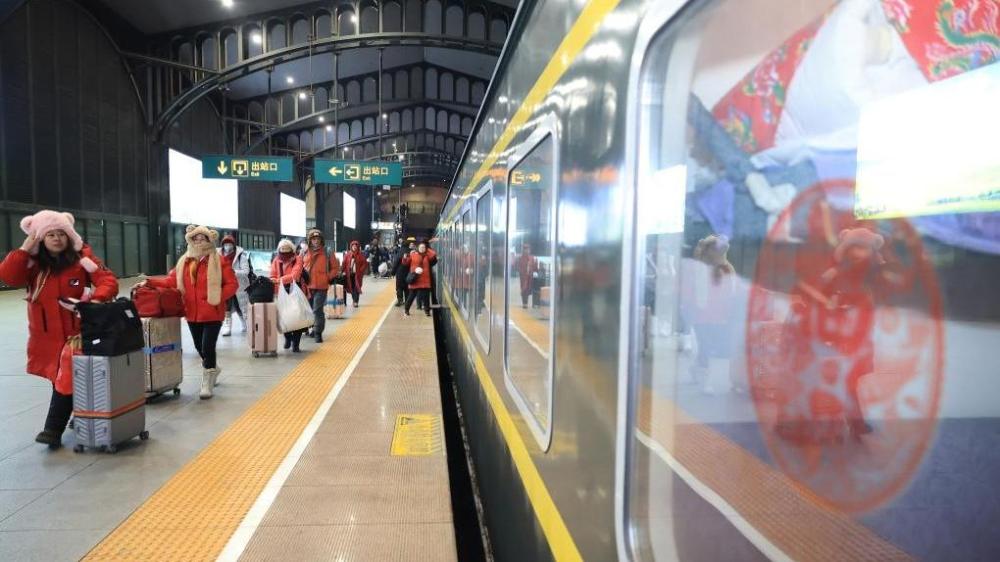
 (Recently, tourists from Southeast Asian countries like Thailand, Vietnam and Malaysia have been flocking to Harbin, hailed as China's 'Ice City,' with unprecedented enthusiasm. Phono by Xinhua.)
By Stephanie LI丨SFC, 21st Century Business Herald
Puffed up. Geared up. Lined up.
Dawn had barely broken over Hekou Port on the China-Vietnam border on New Year's Day when long lines of Vietnamese tourists, luggage in hand, were already waiting eagerly to cross, their sights set on a winter escape.
On Jan 1 alone, more than 3,000 travelers from Vietnam entered China via Hekou in Southwest China's Yunnan province. Many then boarded high-speed trains bound for Jiaozi Snow Mountain in Kunming, the provincial capital, eager to experience snow — a rarity in their tropical homeland.
Recently the phrase "the wind of Harbin has blown all the way to Southeast Asia” - highlighting "extreme temperature contrasts" - became one of the top three trending topics on Chinese social media.
Behind the phrase is a vivid scene: "tropical" tourists from Indonesia, Thailand, and Malaysia wandering the streets in minus 20 to 30 C, phones in hand, capturing their first breathtaking glimpse of the ice and snow.
But of course, Harbin is just one of the most popular destinations as Southwest China is now carving out its own niche in the nation's booming winter tourism market, thanks to its abundant snowcapped mountains, unique ethnic cultures and geographical proximity to Southeast Asia.
Since the start of this year, high-altitude scenic spots across Yunnan, Sichuan and Guizhou provinces in Southwest China have seen a surge in inbound tourists from Southeast Asian countries.
Against this backdrop, scenic areas across the region are upgrading their offerings to meet growing demand. The Potatso National Park in Yunnan's Diqing Tibetan autonomous prefecture has launched an immersive snow-play zone this winter, featuring interactive activities such as sledding and dedicated child-friendly areas where families can dig, build and play in the snow.
In neighboring Sichuan province, high-altitude snow tourism is also gaining traction. Wawu Mountain, with its snow-dusted forests framed by towering, snowcapped peaks, has become a rising star among Thai social media users.
Blessed with unique low-latitude, high-altitude resources, Sichuan has emerged as a budget-friendly alternative for ice and snow tourism in their eyes, dubbed "closer than Europe, more worthwhile than Switzerland". At Siguniang Mountains, the sea of clouds and golden snow-capped peaks are nothing short of a fairyland, drawing hordes of Southeast Asian hikers and photography enthusiasts to snap photos and make memories.
According to a report released last year by China's General Administration of Sport, the country's ice-and-snow economy has experienced leapfrog growth in recent years. The sector's scale expanded from 364.7 billion yuan (USD52 billion) in 2016 to 980 billion yuan in 2024, with an average annual growth rate exceeding 21 percent.
The introduction of the 240-hour visa-free transit and unilateral visa-free policies is reflected just as clearly in the numbers. From Jan 1 to 9, inbound passenger flows at the ports in northeastern Heilongjiang province have grown more than 43.8 percent year-on-year, while Southeast Asian visitors to Xiling Snow Mountain in Sichuan accounted for 70% of foreign visitors during New Year holiday.
Moreover, Harbin airports recently added four new international routes - between Harbin and Ho Chi Minh City and Hanoi in Vietnam, Bangkok in Thailand, and Kuala Lumpur in Malaysia - and increased flights from 87 to 118 per week.
Southwest China is also further leveraging its unique location and enhanced transport networks to attract Southeast Asian tourists. The China-Laos Railway that connects China's Yunnan Province to the Lao capital of Vientiane, has handled over 62.5 million passenger trips since its launch four years ago. And a new high-speed rail link reaching the China-Vietnam border city of Pingxiang in Guangxi officially commenced full operations in December.
While policy determines "if they can come," experience determines "whether it's worth their while." For many visitors from tropical and subtropical regions, a subzero environment is far removed from everyday life.
What truly makes this journey more than just “seeing ice and snow” is China's rich and diverse culture and its vast, eye-opening landscapes. Tourists take home more than just photos and memories, they also get up on speed with the real China.
In recent years, China has deepened its foothold in the international market through a dual strategy of "going global" and "bringing in". By hosting the Hello! China Ice and Snow Tourism Overseas Promotion Season for consecutive years, Chinese ice and snow brands have built targeted reach in Southeast Asian countries including Malaysia and Vietnam.
Observers note a prominent trend among current Southeast Asian tourists: their experience of China’s ice and snow is shifting from mere sightseeing to in-depth cultural exploration, with "living like a local" emerging as a popular travel style.
The Chinese-style modern life unfolds in a perceptible way, forming genuine and lasting connections with the world and allowing China's appeal to be recognized and appreciated.
Due to cultural proximity, Southeast Asian tourists have a profound interest in Chinese culture, and the unique folk customs, winter fishing traditions, ice sculpture art and other cultural elements of China’s snowy escapes hold a special appeal for them.
On the streets, tourists encounter not only natural beauty but also the rhythm of urban order, public facilities, and daily life. The streets are orderly, public transport runs on time, and markets and shops are bustling yet organized. These details provide tourists with a tangible sense of how Chinese cities operate in practice.
It is this layered experience that makes cross-border tourism more than just a consumption activity - it becomes a channel for cultural and lifestyle exchange. Policy convenience opens the door, while China's size and cultural richness provide unique experiences at every turn. And this is perhaps the real appeal of China’s winter tourism that keeps enchanting Southeast Asia.

Editor: LI Yanxia
Host: Stephanie LI
Sound Editor: Stephanie LI
Graphic Designer: ZHENG Wenjing, LIAO Yuanni
Produced by 21st Century Business Herald
Presented by SFC